
Materials comparison
Choosing the best flooring for an outdoor terrace does not depend solely on aesthetics. A terrace is exposed to rain, humidity, solar radiation, temperature changes, and, in many cases, frequent use. Therefore, before choosing a material, it is advisable to analyze its resistance, maintenance, safety, durability, and adaptation to the space.
In this guide, we analyze the main options to help you choose the most suitable flooring for your terrace.
What makes a good outdoor flooring?
Before comparing materials, it is worth defining what characteristics a good outdoor flooring should have.

Weather resistance
The ground will be directly exposed to weather conditions. Rain, humidity, sun, and temperature changes can affect certain materials over time.
Resistance to solar radiation
Continuous exposure to UV rays can cause color changes and surface deterioration in some materials.
Resistance to water and humidity
On an outdoor terrace, it is common for the flooring to be in contact with water. In areas close to swimming pools or gardens, this exposure can be even greater.
Safety
The risk of slipping increases when the flooring is wet. Therefore, especially on terraces, swimming pools, and frequently used outdoor areas, it is important to evaluate the anti-slip characteristics of the material.
Maintenance
Not all outdoor flooring requires the same level of maintenance. This aspect can have a major impact on the cost and time spent on maintenance throughout the terrace’s lifespan.
Durability
The initial cost should not be the only criterion. A material that retains its properties for many years can be more attractive than an initially economical solution that requires frequent replacements or treatments.
Main types of flooring for outdoor terraces
1. Ceramic and porcelain
Ceramic and porcelain are widely used solutions for outdoor terraces. However, they do not provide the same warm and natural feel as wood decking, resulting in a visually cold appearance.
On a terrace where people walk barefoot, a ceramic surface can be less pleasant than a solution specifically designed to provide a warmer feel.
2. Natural stone
Natural stone is a traditional solution for outdoors and offers an aesthetic closely linked to architecture and the landscape.
Granite, slate, limestone, and other stones can be used in different projects, but some stones may require specific treatments, and their characteristics vary considerably depending on the type of stone chosen.
Some stones, especially darker-colored ones, can reach high surface temperatures after several hours of solar exposure.
Natural stone usually has a considerable weight. This can affect transportation, handling, and certain construction systems.
The substrate, slopes, drainage, joints, and installation system are especially important outdoors. An incorrect installation can cause movement, water accumulation, or breakage.
3. Natural wood
Natural wood, once processed into an outdoor product, remains an organic and hygroscopic material. When directly exposed to the weather, it requires proper protection and maintenance systems, such as oils or stains, to limit the effects of moisture, UV radiation, and temperature changes. Without protection, surface deterioration and aging begin, which can lead to cracks, splinters, or fissures.
The applied treatment is not permanent. Over time, exposure to the weather makes it necessary to renew the protection, especially on surfaces heavily exposed to the sun and rain.
One of the most important issues when comparing materials for a terrace is not to look solely at the initial price.
For natural wood installed outdoors, the following must be considered:
Initial price + treatments + maintenance products + labor + renovations during the years of use.
Therefore, the total cost of a terrace must be analyzed throughout its entire lifespan.
4. Conventional synthetic composites
Synthetic composites on the market (commonly known as composite decking) are man-made materials that mix plastic resins with fibers. Although durable, the vast majority have a very high plastic content (around 60% and sometimes even significantly more), frequently using PVC, which is toxic to health and a hazard in the event of a fire (emitting hydrochloric acid when burned), as well as low-quality polymers.
This causes six major problems in everyday use:
- Radiator effect: They heat up excessively under the sun, becoming hot enough to burn when stepped on due to containing so much plastic.
- Artificial appearance: Their high concentration of plastic gives them a purely synthetic shine and feel, losing the warmth of a home.
- Static electricity: They generate annoying shocks when touched due to friction with the polymers.
- Expansion and contraction: They are materials with a high proportion of polymers that tend to experience significant thermal expansion.
- Potential aesthetic degradation: Prolonged exposure to UV radiation can cause color changes or surface aging.
- Composition-dependent recyclability: Not all composites behave the same way at the end of their lifespan. The feasibility of recycling a product depends on its composition, the different materials that comprise it, and the available recovery systems.
5. Accoya wood
Accoya wood has a footprint associated with its industrial transformation. Acetylation is precisely the technology that modifies the wood’s properties. Therefore, in addition to the origin of the wood—which comes from New Zealand and is acetylated, marketed, and distributed from the Netherlands (currently, there is also production in the US)—when comparing solutions, it is also advisable to consider the industrial process used to modify it, the origin of the raw materials, and the product’s behavior at the end of its lifespan.
Accoya retains the aesthetic and physical characteristics typical of wood. It does not offer the same possibilities as a technological composite solution. Without treatment, the wood can evolve into a silvery-gray shade.
6. Bamboo wood
Although commercially referred to as “bamboo wood,” bamboo is a grass, not a tree. While it is commonly stated that the growth of the bamboo plant is very rapid, mature culms are required for industrial applications, and INBAR references usually place maturity/first harvest at around 3-5 years, depending on the species and cultivation system.
To convert it into planks and construction elements, it is normally subjected to transformation processes, such as laminating, pressing, and gluing. The complete process involves cutting, drying, heat treatment, laminating, pressing, adding adhesives, machining, and surface finishes.
A very important part of the bamboo used worldwide originates in Asia, especially China, depending on the product and the manufacturer. On a European project, this can imply a considerable international logistics chain from raw material production to arrival at the construction site, in addition to the polluting effects due to long maritime journeys.
Therefore, if the sustainability criteria include manufacturing proximity and the carbon footprint associated with transport, it is advisable to analyze the specific origin of the product.
A relevant 2024 study on structural laminated bamboo identified electricity, adhesives, and transport as the main sources of emissions.*
* Liu, K.; Durai, J.; Shi, Y.; Xiong, Z.; Yang, J.; Symeonidis, A.; Zea Escamilla, E. (2024). Life cycle assessment (LCA) of the industrial production of structural glued laminated bamboo. Journal of Cleaner Production, volume 485, article 144367. DOI: 10.1016/j.jclepro.2024.144367
7. Hollow WPC decking
Hollow WPC decking features an internal structure that reduces weight and material consumption, but it also means there is less material available to support certain loads compared to a solid plank of equivalent dimensions.
As the hollow chambers are open to the outside, this facilitates the accumulation of dirt, allowing all kinds of waste and sediment to penetrate. Furthermore, since water enters easily, it holds decomposing water inside, leading to the proliferation of microorganisms and insects, which can eventually rot the material. You can continue by sending the next fragment.
If a hollow plank suffers localized deformation or breakage, repair may not be simple, and it may be necessary to replace the entire piece.
Walking on the hollow profiles of hollow WPC decking provides a different feel compared to walking on a solid plank, as the wall thickness and chamber geometry play a fundamental role—drawbacks that solid wood does not have.

8. Capped terrace flooring
Capped flooring cannot be repaired with sandpaper, as is the case with wood, because its surface is 100% plastic; furthermore, some of them can eventually peel and lift sections of their surface, which can flake off in small pieces.
An outer layer with a high proportion of polymer can alter solar absorption, heat transfer, surface temperature, and thermal sensation, which is why this type of terrace with capped profiles is never recommended for swimming pool decks exposed to the sun. In this regard, if this high sun exposure occurs, noticeable changes in its color tone will take place.
Its feel to the touch can never match that of a composite wood that features a natural range.
9. Exclusive to VISENDUM®, with a unique concept
Compared to common plastic composites, the VISENDUM® Natural and Emotion Range breaks the rules of the game by completely reversing the formula to offer a truly premium material:
- 70% PEFC-Certified Natural Wood: It is not plastic with a wood appearance; it is real pine wood, sourced from forest cleanups and sawmills. Without cutting down a single tree! This gives it the noble touch, warmth, and beauty of natural wood, but without its drawbacks, allowing the user to save on the expensive treatments that natural wood requires.
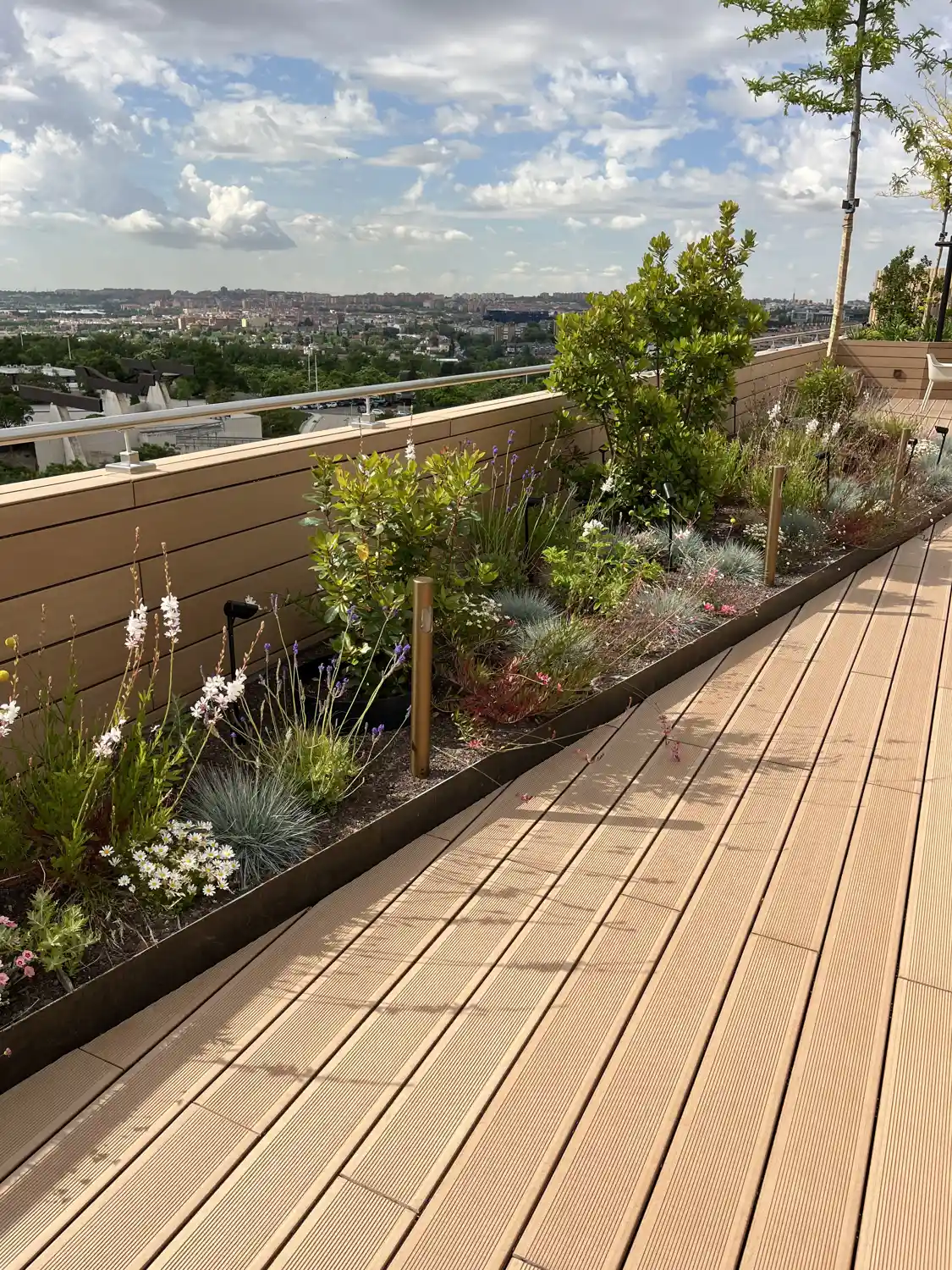
What are its main advantages?
- 0% PVC and Heavy Metals: Its 30% matrix exclusively uses clean and recyclable High-Density Polyethylene (HDPE). It is a healthy, sustainable material free of toxic emissions. Many of the other outdoor materials on the market, which contain a lot of plastic, do have PVC in their composition, with the environmental and health hazards that this entails, and the cancer risk it poses to people.
- Real thermal regulation: Containing 70% wood, the material naturally dissipates heat. It does not burn feet under the sun, allowing you to enjoy the terrace barefoot even in the middle of summer.
- Goodbye to static and slips: Its high molecular density completely eliminates static shocks and offers maximum grip (DIN 51097 Class 3 anti-slip – exceeding CTE DB-SUA/1 test 41901:2017 EX), ideal for pool areas.
- Circular Sustainability: Manufactured entirely with wood by-products and under PEFC certification, caring for the planet while elevating outdoor design.
- 100% solid and chamber-free: There are no internal chambers, there are no internal hollows where water can accumulate; it allows machining, special cuts, curves, the manufacture of custom pieces, and greater design freedom.
- The profiles of the VISENDUM® Natural Range feature a solid and homogeneous structure, with the same composition in mass and surface: This distinguishes it from hollow solutions and, conceptually, from products whose surface performance depends on a capped layer.
- No trees are cut down to manufacture VISENDUM®: The 70% of PEFC pine in its composition comes from remnants of responsible forest management.
- Total resistance to extreme climates (Test EN 321): VISENDUM® proves its resistance to sudden temperature changes, frosts, or extreme heat.
- Stable color: It does not turn drastically gray in the sun, as happens with Accoya wood or natural stone, maintaining a uniform aesthetic.
- Zaragoza manufacturing and origin: It is manufactured on the banks of the Ebro, guaranteeing compliance with national and EU regulations and drastically reducing the logistics carbon footprint, unlike wood or composites massively imported from China or the tropics.
- Triple contribution to environmental certification: It is one of the few materials that actively scores points for obtaining the prestigious sustainable architecture seals LEED®, BREEAM®, and VERDE.
- Free of rice husk silicates: Its composition dispenses with these cheap compounds (common in other lower-quality decking), ensuring a clean matrix that does not compromise the long-term resistance of the profile.
- Durability warranty (up to 25 years): It has official technical support against degradation by fungi, termites, and wood-boring insects outdoors, without losing performance.
- Ultra-long-term reuse: The system and the nature of the material itself are technologically designed to allow the reuse and recycling of the material over an estimated lifespan of up to 250 years.

Comparison of the main types of outdoor flooring
| Feature | VISENDUM® | Ceramic / Porcelain | Natural Stone | Natural Wood | Bamboo | Accoya | Synthetic Composite | Capped | Hollow |
|---|---|---|---|---|---|---|---|---|---|
| Does not generate static electricity | ✓ | ✓ | ✓ | ✓ | ✓ | ✓ | ✗ | ✗ | ✗ |
| Anti-slip + CTE | ✓ | ✗ | ✗ | ✗ | ✗ | ✗ | ✗ | ✗ | ✗ |
| UNE 41901:2017 EX | ✓ | ✗ | ✗ | ✗ | ✗ | ✗ | ✗ | ✗ | ✗ |
| DIN 51097 – Class C | ✓ | ✗ | ✗ | ✗ | ✗ | ✗ | ✗ | ✗ | ✗ |
| DIN 51130 – R12/R13 | ✓ | ✗ | ✗ | ✗ | ✗ | ✗ | ✗ | ✗ | ✗ |
| Stable color | ✓ | ✓ | ✗ | ✗ | ✗ | ✗ | ✗ | ✗ | ✗ |
| EN 321 – extreme climates | ✓ | ✗ | ✗ | ✗ | ✗ | ✗ | ✗ | ✗ | ✗ |
| Not mostly imported from China / tropics | ✓ | ✓ | ✗ | ✗ | ✗ | ✓ | ✗ | ✗ | ✗ |
| LEED contribution | ✓ | ✗ | ✗ | ✗ | ✗ | ✓ | ✗ | ✗ | ✗ |
| BREEAM contribution | ✓ | ✗ | ✗ | ✗ | ✗ | ✓ | ✗ | ✗ | ✗ |
| VERDE contribution | ✓ | ✗ | ✗ | ✗ | ✗ | ✗ | ✗ | ✗ | ✗ |
| Wood texture/warmth + thermal comfort | ✓ | ✗ | ✗ | ✓ | ✓ | ✓ | ✗ | ✗ | ✗ |
| No treatment required | ✓ | ✓ | ✓ | ✗ | ✗ | ✓ | ✓ | ✓ | ✓ |
| 70% PEFC recycled pine | ✓ | ✗ | ✗ | ✗ | ✗ | ✗ | ✗ | ✗ | ✗ |
| Free of PVC and rice husk silicates | ✓ | ✓ | ✓ | ✓ | ✓ | ✓ | ✗ | ✗ | ✗ |
| Custom manufacturing: curves, 6 m, stair nosings, railings… | ✓ | ✗ | ✗ | ✗ | ✗ | ✗ | ✗ | ✗ | ✗ |
Which flooring to choose depending on the type of terrace?
Residential terrace
The priority is usually to combine aesthetics, comfort, resistance, and ease of maintenance.
Terrace next to a swimming pool
Here, water resistance, performance against humidity, and anti-slip properties become especially important.
Hotel terrace
In addition to aesthetics, traffic, durability, and maintenance must be considered.
Restaurant terrace
Heavy use makes it especially important to choose a resistant and easy-to-maintain flooring.
Public space terrace
In this case, the technical performance, expected traffic, safety, maintenance, and specific project requirements must be carefully analyzed.
And what about maintenance?
Natural wood and bamboo require periodic treatments to maintain their appearance and protect them against environmental conditions.
Ceramic and certain types of stone may require relatively simple maintenance, although this will depend on the material and the installation system.
In the case of VISENDUM®, it is designed for outdoor use and does not require the periodic treatments typical of certain natural woods or bamboo.
Which flooring is best for a terrace that gets a lot of sun?
When a terrace is subjected to high sun exposure, special attention should be paid to:
- Resistance to UV rays.
- Color stability.
- Performance against temperature changes.
- Dimensional stability.
- Surface temperature.
- Manufacturer’s warranty.
It is not enough to choose a material based on its initial appearance. It is important to know how it will perform after years of outdoor exposure.
Which flooring is the best for a terrace with a pool?
In a pool area, priorities change.
- Water.
- Constant moisture.
- Solar reflexion.
- Temperature changes.
- Barefoot traffic.
- Products used in pool maintenance.
In addition, safety must play a leading role.
Therefore, before choosing flooring for a swimming pool, it is advisable to specifically check the product’s anti-slip performance and its behavior under wet conditions.
VISENDUM® offers Outdoor Decking solutions for pool areas, integrated within its various outdoor applications.
The importance of choosing the installation system correctly
A good outdoor flooring does not depend solely on the material.
The installation is equally important.
In outdoor decking systems, the following aspects must be analyzed, among others:
- Substructure.
- Joist spacing.
- Gap between profiles.
- Drainage.
- Ventilation.
- Expansions.
- Surface fixings.
- Slopes.
- Transitions to other materials.
An incorrect installation can affect the performance and durability of any outdoor flooring.
That is why the installation system must be considered as part of the complete solution.
What to consider before buying outdoor flooring?
Before making a decision, we recommend comparing at least these points:
1. Technical datasheet.
2. Composition.
3. Wheater resistance.
4. UV resistance.
5. Anti-slip properties.
6. Treatment required.
7. Installation system.
8. Warranty.
9. Origin and manufacturing.
10. Sustainability and recyclability
.Not all products that visually look similar offer the same performance.
Conclusion
The best outdoor flooring is the one that best adapts to the project
Choosing the best flooring for an outdoor terrace requires analyzing its use, climate, sun exposure, humidity, maintenance, safety, and aesthetics.
When looking for the best performance specifically designed for the outdoors, VISENDUM® Technological Platform is the best choice on the market today.
At VISENDUM®, we develop and manufacture solutions for terraces, gardens, swimming pools, facades, and other outdoor spaces, with different designs and applications.

